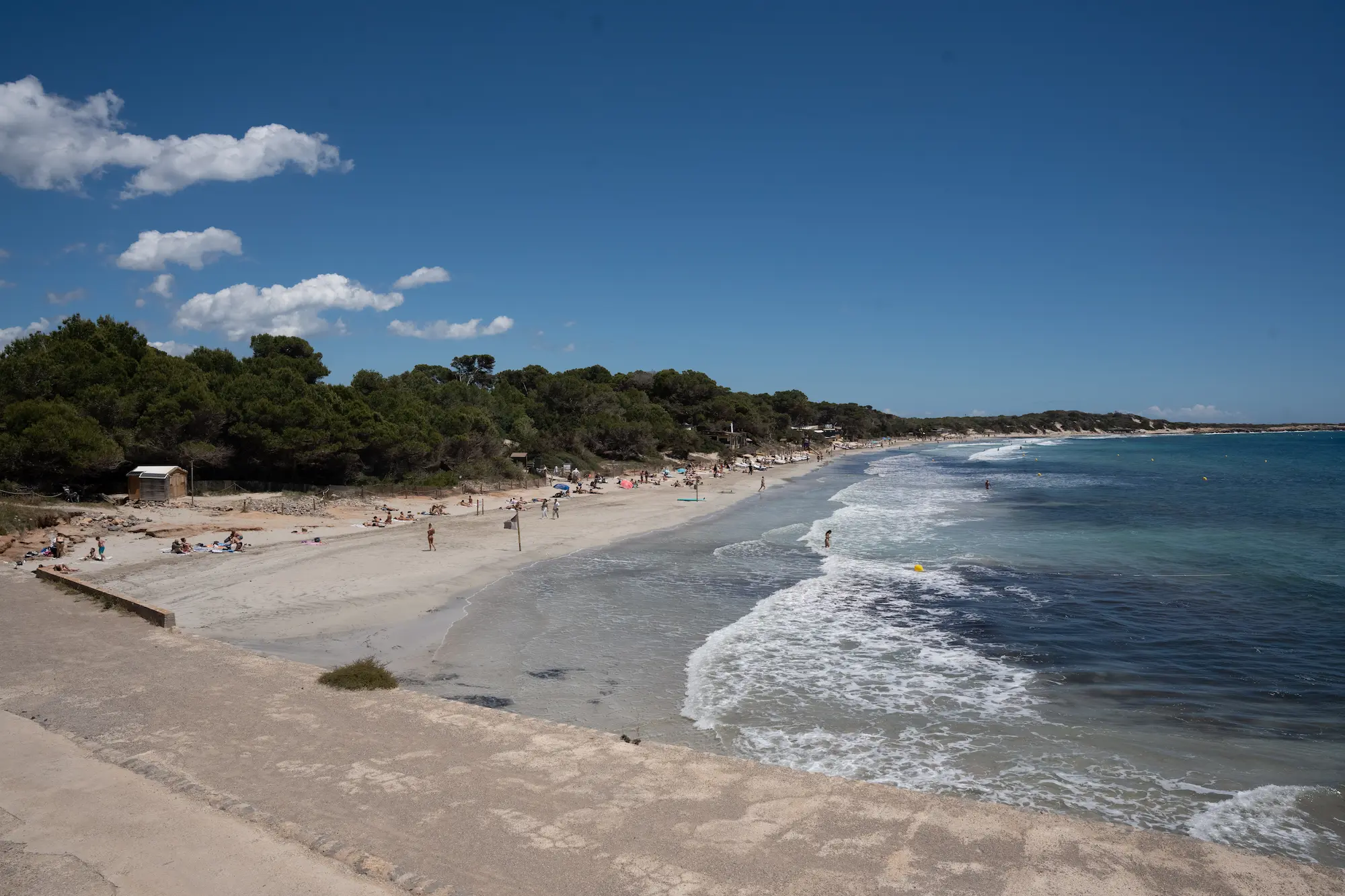
Almost everyone who comes to Ses Salines parks, spends the day on the sand and leaves. And misses the best of it.
A few metres from the beach begins one of the most interesting natural spaces in Ibiza: centuries-old salt ponds, pirate towers, dunes and around 210 bird species. You can explore it on foot or by bike, and in low season it is practically yours alone.
What this park is
The Ses Salines Natural Park covers the south of Ibiza, the north of Formentera and the sea that separates the two islands. Inside there are beaches, wetlands, pine forests and the posidonia oceánica meadows that make the water here so clear. The best known is the Ses Salines beach, which you reach along the same road.
That posidonia is part of what was declared a UNESCO World Heritage Site in 1999. It is worth being precise, because it is often repeated inaccurately: what is protected is the marine ecosystem and the posidonia, not the beaches themselves.
The salt pans, which are still working
This is not a set. Salt is still being produced here, just as it has been for centuries.
Seawater enters the ponds and passes from pool to pool. It starts at the 36 grams of salt per litre normal for the Mediterranean and concentrates until it exceeds 170 in some points. In that hypersaline water live a microscopic algae and a bacterium which are responsible for the pinkish tint you see in the pools. And also living there is the small crustacean that flamingos feed on.
Eventually the water reaches the crystalliser ponds, which are shallower, where the salt is harvested. This usually happens in September and October.
It is a nice detail to tell children: the pink colour of the water and the pink colour of the flamingos come from the same place.
When you can see flamingos
This is the question we get most, so here it is clearly: flamingos can be spotted from February to May and from July to October, before heading on towards Africa.
They are not there all year and no specific day is guaranteed. But if you come in those months and go early in the morning or at sunset, your chances are good.
The park has observation platforms scattered around the ponds, and one of them is very close to the church of Sant Francesc. At the interpretation centre they can lend you binoculars.
And it is not just flamingos. Around 210 species pass through or nest here: black-winged stilts, black-necked grebes, herons, plovers. Autumn and winter are among the best times for birdwatching in all of the Balearics, when the summer image of Salinas has nothing to do with what you find. If you come out of season, see also what else there is to do in Ibiza in winter.
What to visit inside the park
Torre de Ses Portes. Built in the 16th century to defend against pirates and protect the salt shipments. It sits between the beaches of Ses Salines and Es Cavallet, and the walk to it is one of the most beautiful on the island. At its foot you will see the boathouse shelters where fishermen keep their llaüts. If you climb the hillock behind it, you have all of Playa d’en Bossa in front of you.
The church of Sant Francesc de s’Estany. From the 18th century, small and very simple, built so that the salt workers could attend mass. It stands beside the ponds and has a charm you do not expect.
The interpretation centre, with the salt workers’ tools and the history of the trade. A good stop if you are visiting with children or if you feel like understanding what you are looking at.
Es Cavallet and Sa Trinxa. The beach next door and the beach bar (*chiringuito*) at the southern tip, with the best-known sunset in the area.
How to get around it
The park has several waymarked itineraries you can do on foot or by bike. There are short ones, a stroll between the pools, and longer ones: the full circular route can reach 10 kilometres, linking the salt pans, towers, dunes and beach.
A very rewarding route starts from the car park on the Es Cavallet road and keeps changing scenery throughout, with stretches of sand and stretches of pine forest.
Three things worth keeping in mind:
- Pick your time carefully. Walking around here at three in the afternoon in the middle of July is a bad idea. Go early or late.
- Bring water and a hat. There is very little shade between the ponds.
- Stay on the paths. This is a protected space and the nesting areas are fragile.